The global healthcare AI market keeps growing at double-digit rates year after year. In Panama, adoption has been slower than in countries like Colombia or Mexico, but the landscape is changing fast. Clinics that adopt AI now get ahead of a market that is still in its early phase in the region.
This article lays out the main AI applications available for Panama's healthcare sector today, focusing on what's accessible and practical for small to mid-sized private clinics.
What is AI applied to healthcare?
Healthcare AI ranges from imaging-diagnosis systems to chatbots that serve patients. For private clinics in Panama, the most relevant and accessible applications are:
- Conversational assistants: serve patients on WhatsApp, Facebook, Instagram and web.
- Booking automation: manage appointments with no human intervention.
- Predictive analytics: identify which patients are most likely to no-show.
- Transcription and documentation: automatically document visits by voice.
- Smart marketing: segment patients and personalize communications.
The current state of healthcare AI in Panama
Panama has characteristics that make healthcare-AI adoption especially viable:
- High smartphone penetration: most patients walk into the office with an internet-connected phone in their pocket.
- WhatsApp as the dominant channel: it is the app Panamanians already use every day, businesses included.
- A robust private health sector: Panama has one of the highest ratios of private clinics per capita in Central America.
- Unmet demand: wait times at private clinics in Panama City average 12 days for specialists.
A concrete opportunity: today most first contact with a private clinic in Panama happens over WhatsApp or social media, not by phone. When a patient is comparing options, they stay with whoever replies first — and replying first, at any hour, is exactly what an assistant automates.
The 4 most relevant AI applications for Panamanian clinics today
1. Conversational AI assistants
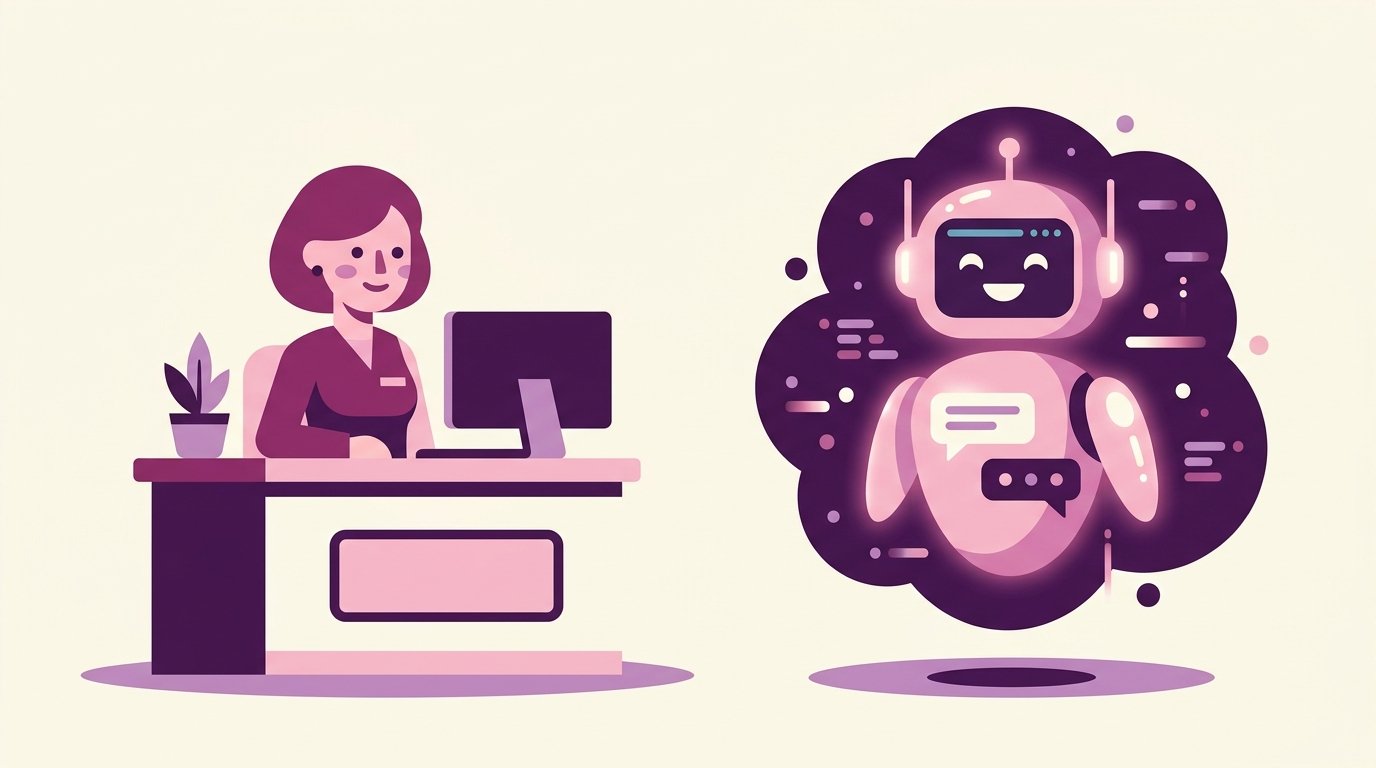
These are the most accessible application with the highest immediate return. An AI assistant like NahIA can serve your clinic's patients 24/7 on WhatsApp, answer questions about services and pricing, book appointments in your Google Calendar and send automatic reminders — all without hiring extra staff.
The implementation cost is considerably lower than a full-time employee, and availability is total: weekends, holidays and the middle of the night.
2. AI for appointment management and reminders
AI scheduling systems don't just book — they learn your clinic's patterns and can predict which time slots are most likely to no-show, suggest when overbooking makes sense, and proactively reach out to patients who haven't returned in more than 6 months.
3. Conversation and satisfaction analysis
Language models can analyze WhatsApp conversations and extract insights: which questions patients ask most, which complaints are most frequent, which aspects of the experience drive the most satisfaction. This information is worth more than any traditional survey.
4. AI-powered personalized marketing
Segmenting patients by history, specialty consulted and behavior lets you send relevant messages at the right moment. A patient who came in for dermatology 6 months ago can get a personalized follow-up message — not a generic mass blast.
What does a clinic need to adopt AI?
The barrier to entry is lower than you think. To implement a conversational AI assistant like NahIA, you need:
- A dedicated WhatsApp number for the clinic.
- Google Calendar (or the scheduling system you already use).
- An email address for notifications.
- 48 hours of setup with the NahIA team.
You don't need your own technical infrastructure, servers or programming knowledge.
The cost of waiting
Healthcare-AI adoption in Latin America is growing at double-digit rates every year, in line with the market projection cited above. Clinics that implement these tools in the next 12 months will have an edge in service, efficiency and patient acquisition that's hard for latecomers to match.
This isn't about replacing the doctor — it's about letting the doctor focus on what only they can do: diagnose and treat. Everything administrative can be automated today.
Is it legal to use artificial intelligence with patient data in Panama?
Yes, it is legal, as long as you comply with Law 81 of 2019 on personal data protection, in force since March 2021 and regulated by Executive Decree 285 of 2021. The law classifies health information as sensitive data, which means the clinic needs the patient's prior, informed and unequivocal consent before processing it, and that consent must be documented and revocable. In practice, an AI assistant can coordinate appointments, answer questions about services and send reminders without touching clinical information; when a conversation includes health data, the system must request consent, restrict access to authorized staff and store the information with security measures. The authority that oversees compliance is ANTAI, which can impose sanctions on anyone processing sensitive data without a legal basis.
Before activating any AI tool, verify three points with your provider:
- Where conversations are stored and who on your team can read them.
- How patient consent is recorded and how it can be revoked.
- What happens to the data if you cancel the service: it must be exportable or deletable on request.
What do international health organizations say about AI in healthcare?
The Pan American Health Organization published its eight guiding principles for the digital transformation of the health sector, and two of them speak directly to this topic: the use of artificial intelligence with safe, equitable algorithms, and information security to protect sensitive health data. This isn't a software-vendor fad — it's the official direction PAHO has set for the entire region.
The market is moving the same way: Grand View Research projects that AI in healthcare will reach $187.7 billion by 2030, growing at a 38.5% compound annual rate from 2024. That pace has a concrete consequence for a clinic in Panama: the tools will get cheaper and more capable every year, but the competitive advantage goes to whoever already has their processes in order when they arrive.
How to start with AI without risking your clinic's operation
The most common mistake is trying to automate everything at once. The lowest-risk path is a scoped pilot:
- Weeks 1-2: automate only the answers to frequent questions (hours, location, pricing) outside business hours.
- Weeks 3-4: turn on automatic booking for a single specialty or a single doctor.
- Month 2: add appointment reminders and measure the no-show rate against the previous month.
- Month 3: extend to the rest of the schedule if the numbers hold up.
With this approach, your team supervises every stage and no patient goes unattended if something fails. Check NahIA's plans and pricing to size the pilot for your clinic.
Rule of thumb: if after 90 days the assistant hasn't reduced no-shows or freed up measurable front-desk hours, adjust it or switch tools. AI in healthcare is justified by numbers, not by novelty.
Frequently asked questions
Is it legal to use artificial intelligence with patient data in Panama?
Yes, as long as you comply with Law 81 of 2019 on personal data protection: informed consent, a declared purpose and security measures. The clinic remains the data controller and the provider acts as processor.
Does AI replace clinic staff?
No. It handles the repetitive volume — pricing, availability, booking, reminders — and hands over to a person the cases that need judgment. The front desk gains time for in-person care.
What does a clinic need to start using AI?
A WhatsApp Business number, the information about services, practitioners and hours, and a calendar. No infrastructure of your own, no servers and no programming knowledge.
How long does implementation take?
Standard implementation is 48 hours from signing to going live.